
12 Most Interesting FNAF Fan Theories
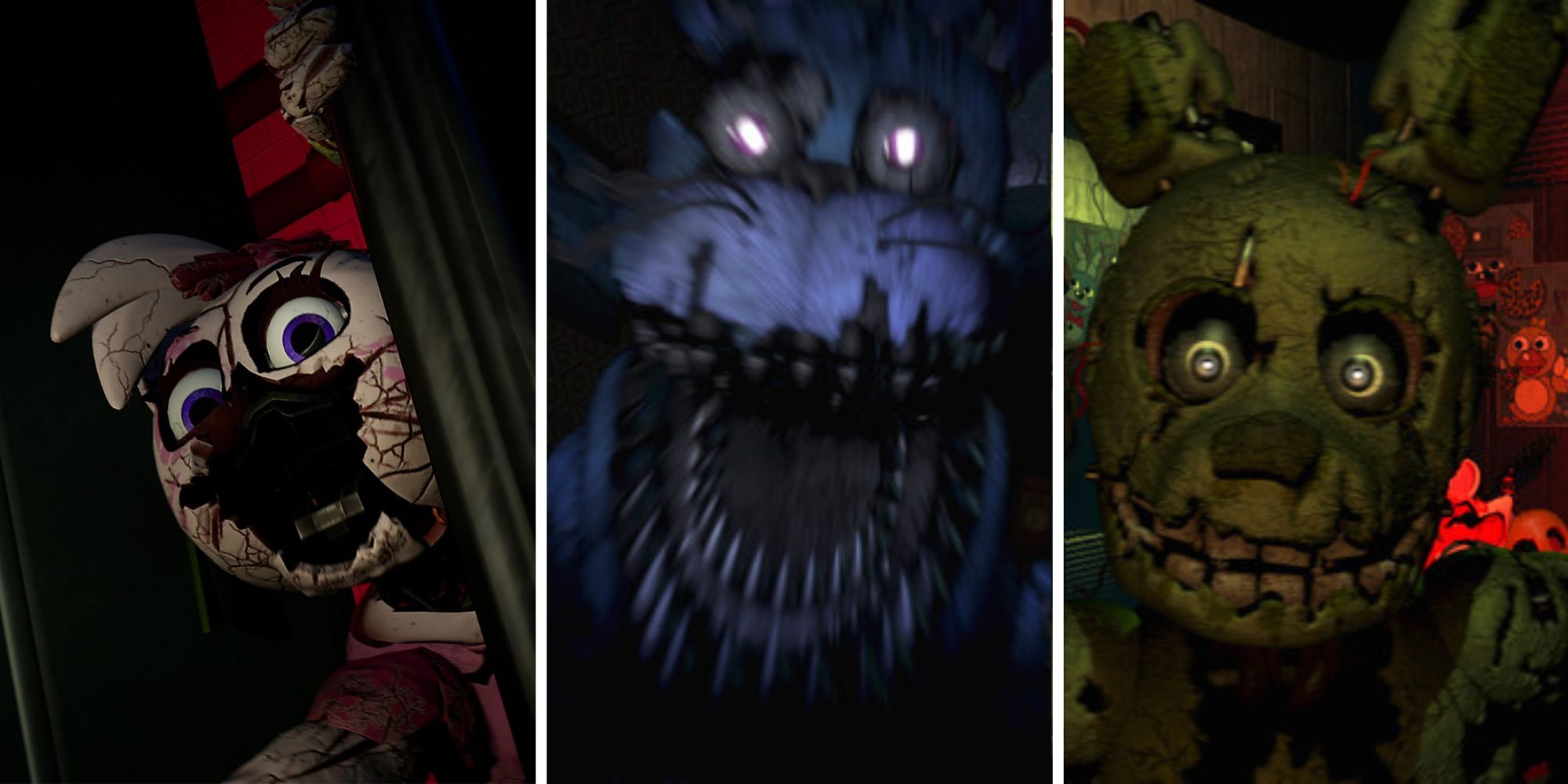
Five Nights at Freddy’s lore is a labyrinth, and the community owes a lot to Matthew Patrick—better known as MatPat—for mapping it out.
His theories introduced millions to the mysteries lurking behind the jump scares. But the story didn’t stop there. Over the years, countless fans have added their own discoveries, reshaping our understanding with every new clue.
What’s wild is how long this conversation has lasted. Back in high school, I spent recess dissecting theories with a friend just as obsessed as I was. A decade later (Happy 11th birthday, FNAF), the FNAF community is still at it, proving Scott Cawthon created something that will outlive us all.
Related
10 Games To Play If You Like Five Nights At Freddy’s
From Slender: The Eight Pages to Alien: Isolation, these horror titles will surely appeal to many fans of Five Nights At Freddy’s.
As an author, it’s inspiring—FNAF may have started as a straight-up horror game, but become so much more—a storytelling phenomenon that has gripped the cultural zeitgeist in its animatronic clutches, and won’t let go.
With that in mind, I’ve rounded up 12 of the most interesting FNAF theories that persist to this day.
12 Crying Child’s Identity
The Kiddo Behind The Bite Of ’83

Crying Child, often identified as Evan Afton, is at the heart of the FNAF story, and his tragic role in FNAF 4—along with the unsettling hints in The Survival Logbook—reinforces the theory that he’s William Afton’s youngest son.
He’s also the unfortunate victim of the Bite of ’83, a story that echoes the lingering terror found in other grotesque horror games.
Clues hidden in the games and expanded media, like The Fourth Closet novel, solidify his tragic role in the Afton family’s downfall. His story might connect directly to Michael Afton’s journey, further proving that Evan’s fate set the course for the horrors that followed. But then again, maybe his name is Dave.
11 The Date of the Missing Children’s Incident
When Did It All Go Wrong?

The Missing Children’s Incident is widely accepted to have occurred in 1985, with overwhelming evidence from newspaper clippings in FNAF 1 and indirect references in FNAF 2.
This date aligns with Freddy’s original pizzeria timeline and matches the disappearance of the children whose spirits possess the animatronics.
Although 1983 and 1987 are significant years in FNAF’s timeline, the incident that defined the franchise’s dark history is most consistently traced to 1985, as indicated by hidden messages and Fazbear Entertainment’s attempt to move on from the tragedy.
10 William Afton Has Two Houses
Two Lives; Two Dwellings

The theory that William Afton maintained two separate residences—one for his family, the other for his experiments—is backed by environmental storytelling across FNAF 4 and Sister Location.
The suburban home setting in FNAF 4 contrasts with the underground facility in Sister Location, suggesting Afton compartmentalized his life to keep his sinister activities hidden.
This duality is further supported by the presence of surveillance equipment and underground tunnels, indicating that Afton’s work extended far beyond what his family may have known.
9 CharlieFirst vs BVFirst
Whose Life Was Taken First?

The timeline debate over whether Charlie (the Puppet) or the Bite Victim died first hinges on key moments in the series.
The FNAF 2 “Take Cake to the Children” mini-game suggests that Charlie’s murder came before the Missing Children’s Incident, setting the stage for Afton’s crimes.
Meanwhile, the Bite of ’83 in FNAF 4 represents a personal tragedy within the Afton family. Evidence from gravestones in FNAF 6 and the novel trilogy points to Charlie’s death preceding the Bite, making her the true catalyst for the events that followed.

Related
10 Best Horror Games With No Combat
Take the stress out of survival!
8 The Contents of the Mound Don’t Matter
Symbolism Over Substance?

The mound seen in the Midnight Motorist mini-game has sparked numerous theories, but many argue that it serves as a symbolic representation rather than a literal burial.
There has been speculation that the grave belongs to Crying Child—if you believe Crying Child is dead. It’s also been suggested that the grave contains the FoxyBro mask, which would prove, to some, that FoxyBro is Michael Afton and that Good ol’ Mike tortured his little brother and directly caused The Bite of ’83.
Others say that the mound doesn’t matter. The community has widely established Crying Child as an Afton, Michael Afton as his older brother, and The Bite of ’83 is then Michael’s fault. Digging up the grave won’t tell us anything new at this point. Or would it?
7 Five Nights at Freddy’s is Propaganda
Fazbear Entertainment Tried To Cover Its Tracks

FNAF: Help Wanted directly supports the theory that Fazbear Entertainment used media—including the games themselves—as propaganda to cover up their dark past. Running and hiding is something Fazbear Entertainment and the player have in common.
In-game audio logs describe efforts to discredit rumors and control the public perception of past events. The series’ inconsistent timelines and scattered evidence could be deliberate tactics within the lore to obfuscate the truth.
This theory, reinforced by Fazbear’s shady corporate history, presents a chilling meta-narrative where the player is unknowingly consuming a twisted version of events fabricated by the company.
6 Crying Child is FilmVictim
Yes, The Movie Is Canon…

The FilmVictim theory suggests that Garrett, Mike’s younger brother in the FNAF movie, could parallel Crying Child, though there’s a big difference in how they die—Garrett is killed by William Afton, not in the Bite of ’83, in the jaws of arguably the most influential horror game mascot of all time.
Some see a connection, but a lot of the community doesn’t buy the movie as canon, even though Scott Cawthon has said that the books and movies—while separate continuities to each other and the games—are definitely canon.
Even so, it’s all just speculation. If the movie universe holds up, Garrett could be Crying Child lingering at Freddy’s as a spirit, still under Afton’s control. But like most FNAF lore, it’s all up in the air for now and could change with new reveals.
5 Freddy Fazbear’s Pizza Place is Fredbear’s Family Diner
Talk About Building On Top Of A Graveyard

Strong evidence suggests that Freddy Fazbear’s Pizza Place, seen in FNAF 6—and potentially Sister Location—is actually a remodeled version of the original Fredbear’s Family Diner.
The decayed structure and leftover elements from past establishments support this connection. In-game clues, such as blueprints and reused animatronic parts, imply that the location underwent multiple rebrands over the years.
This theory is further reinforced by Fazbear Entertainment’s history of covering up their past by repurposing locations rather than demolishing them, creating a layered history within the same walls.
Let’s not forget the refurbishment of creepy animatronics—post-catastrophe—rather than putting them out of service.

Related
10 Underrated Indie Horror Gems
As Halloween draws closer, it’s a great time to explore underrated horror gems, including games. Here are some indie games that could use more love.
4 The Nightmare Animatronics Represent Common Childhood Fears
They’re Not So Scary In The Daylight

The Nightmare animatronics in FNAF 4 don’t just seem like exaggerated versions of the originals—in fact, this theory suggests they’re designed to reflect universal childhood fears. Not all horror games are scary; FNAF is terrifying.
From fear of the dark to paranoia about closet monsters, these creatures embody deep-seated anxieties. Their distorted, grotesque appearances—sharp teeth, glowing eyes, and uncanny movement—tap into the primal fears children experience when left alone at night.
The game’s mechanics, including doors and listening for noises, reinforce this psychological terror, making it clear that these nightmares are manifestations of real-world fears rather than literal threats.
3 FNAF 1 Took Place in 1994
Yet Another Date Thrown Into The Mix

Although the prevailing belief places FNAF 1 in 1993, compelling evidence suggests it might have taken place in 1994 instead.
Paychecks in the game reference 1993, but a deeper analysis of franchise timelines, along with hints from FNAF 2 and Sister Location, imply a slightly later date.
Inventory records, corporate changes, and Fazbear Entertainment’s restructuring all point to the idea that the events of the first game occurred in the aftermath of significant company shifts in the mid-’90s.
2 Mike Schmidt Is Michael Afton
Maybe They Share More Than Just A Name

The connection between FNAF 1’s security guard, Mike Schmidt, and Michael Afton is heavily supported by in-game dialogue and later installments in the series.
Michael’s journey of redemption, as outlined in Sister Location, aligns perfectly with Mike’s employment at Freddy’s.
The name similarity, coupled with the ending monologue in FNAF 6, might leave little doubt that Mike Schmidt was a false identity used by Michael in his pursuit of his father.
This connection ties the series together and adds personal stakes to every shift he took at every location.
1 Ennard May Have Created Mangle
A Mangled Theory, Or Is It?

The parallels between Ennard and Mangle are too strong to ignore. Both share a tangled, cobbled-together appearance and a similar function—manipulation of endoskeletons and voice mimicry.
The theory suggests that Ennard, after escaping, could have inspired or directly influenced the creation of Mangle, with both serving as evidence of Fazbear Entertainment’s failed attempts at combining animatronic parts—sort of like a horrific, creepy puzzle.
Their fragmented, chaotic designs reflect a recurring theme in FNAF—corporate neglect leading to unpredictable horrors.

Next
Five Nights At Freddy’s: Every Game In The Series, Ranked
The Five Nights At Freddy’s series is the true king of mascot horror. This list breaks down the best in the series for your animatronic horror fix.


