
10 Best Games That Nail Multiple Genres
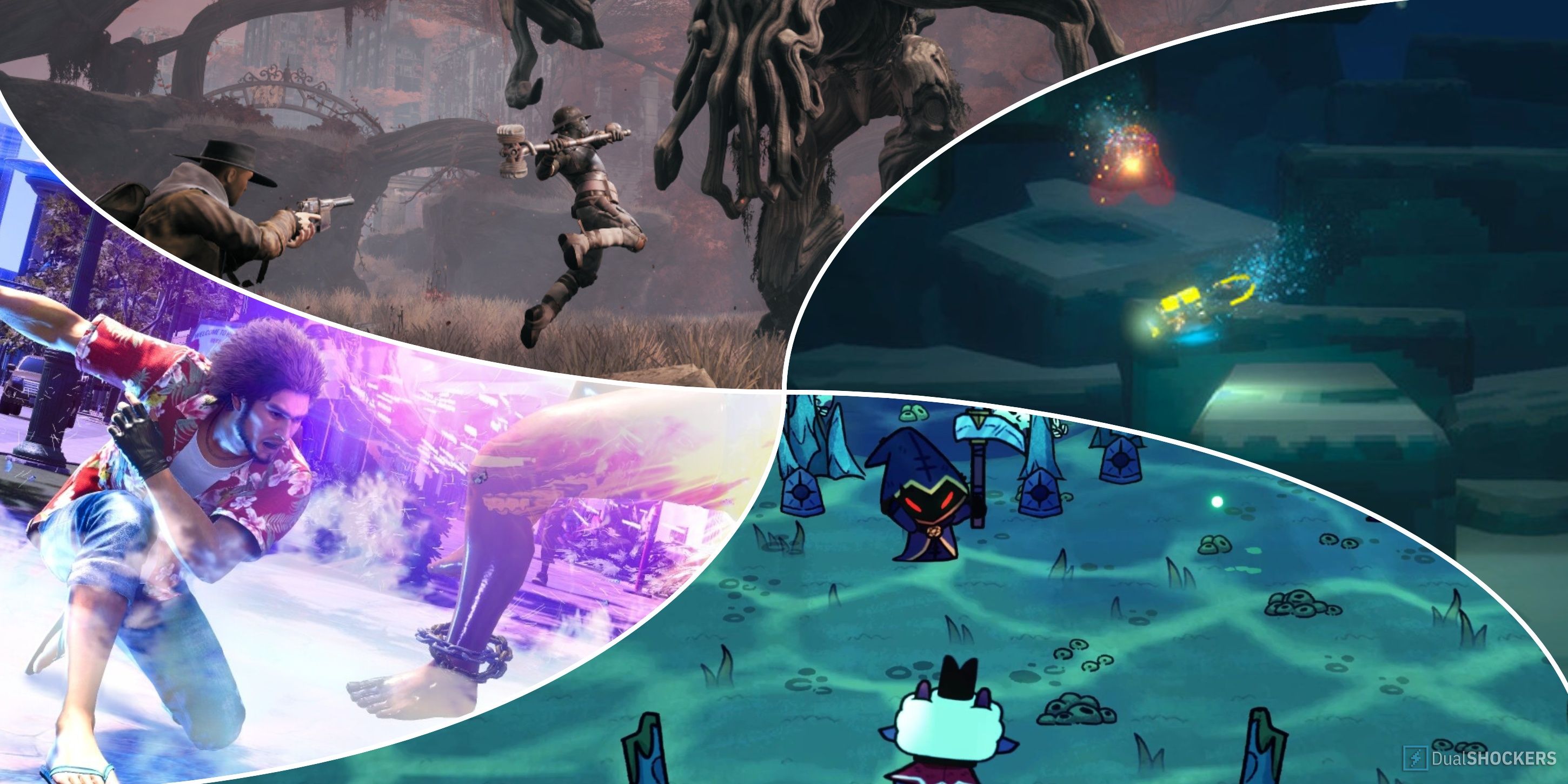
In the olden days of gaming, it was a tall enough order to make a game like Super Mario Bros. that covered exactly one genre. You could be a platformer, you could be a management game, you could be a dungeon-crawler, and so on, but never the twain shall meet.
You could attribute this to the medium merely being young, as well as technical limitations, but it’s been more than long enough that both of those limitations have been surmounted.
Related
10 Gaming Genres That Have Been Done To Death
All I ask for is one unique thought.
In the modern age, games cross genres all the time. Honestly, it’s harder to find a game that sticks exclusively to one genre than one that tackles at least a couple these days. Sometimes, these genre mixes don’t quite pan out, or the attempt is walled off from the core gameplay loop entirely.
Some games, however, manage to meet that magic middle, achieving an ideal balance between multiple different genres to create something wholly distinct. These are some of those precious few games.
10
Peglin
Roguelike Deckbuilder And Casual Puzzle

|
Release Date |
August 27, 2024 |
|---|---|
|
Developer |
Red Nexus Games Inc. |
|
Publisher |
Red Nexus Games Inc., IndieArk |
Roguelike genre hybrids have become very common in the current era of gaming, likely because you can mash roguelikes up with pretty much any other genre with a little bit of ingenuity. Some of these hybrids can be a little lopsided in their priorities, though, favoring the roguelike stuff over whatever’s getting mixed in. One example of a game with a more balanced mix is Peglin.
Peglin is a mash-up of roguelikes (roguelike deckbuilders specifically) and casual puzzle games like Peggle. The basic loop is the same as Peggle’s: you launch a ball into a little board full of tiles and pegs, accruing points as it hits them.
The rub is that those points aren’t just for their own sake; the points you accumulate are translated into damage dealt by your little goblin dude to the enemies that oppose him.
Additionally, as you progress, you pick up items and weapons that modify how the board works, as well as different ball types that deal damage differently or have special effects. You need to be good at Peggle, baseline, but you also need to know how to create a viable damage-dealing and damage-resisting deck of power-ups.
9
Undertale
RPG And Bullet Hell

I remember, back in the mid-2000s, bullet-hell games were squarely in the territory of obscure or indie games, barring some outliers like Ikaruga. Into the 2010s, though, many people who cut their teeth on those sorts of games in years prior had begun making games themselves, and one of them just happened to be Toby Fox.
Fox is on record on his Twitter that he’s been a fan of the Touhou series since he was ten, which explains a lot about Undertale.
Undertale is, on the surface, a straightforward indie RPG, built around stats, items, and random encounters. Of course, anyone who’s played Undertale knows that’s just one of the ways the game tricks you. Those encounters, in particular, involve a myriad of different bullet hell segments, with every enemy type in the game having their own unique shot patterns and mechanics.
The usage of bullet hell mechanics in combat also ties into the game’s morality element. By deftly avoiding every incoming shot, you never need to fight back against any enemy, opting instead for Mercy. However, if you’d rather just tank the damage, you’d need to kill Monsters to increase your health.
8
Battle Chef Brigade
Action Platformer And Match-Three Puzzle

I’ve never had much of a head for cooking. There are just too many moving parts, ingredients you need to portion out, dishes and cups that need measuring. If cooking were as simple as a match-three puzzle game, I’d probably be better at it, even if I had to go outside and get into a knife-fight with a dragon every few minutes. I guess that explains why I enjoyed Battle Chef Brigade.
Battle Chef Brigade is a hybrid of action platformer games and match-three puzzlers. The idea is that you’re in an Iron Chef-style competition to create the tastiest dish you can. To make a dish, though, you need to run outside and kill a bunch of monsters to harvest their parts as ingredients.
Once you’ve got ingredients, you run back, add them to the pot, and stir it around to rotate the colored dots, matching them up to score points and give the dish form.
It feels like something that would swiftly become too hectic to manage, but the whole loop actually ties together very well. You need to optimize your little mini-hunts to get what you need, only add ingredients you can use, and utilize kitchen gadgets like a slow cooker to save you time while you’re busy.
7
Remnant: From The Ashes
Soulslike And Third-Person Shooter

Soulslike games are typically melee-focused affairs. There may be ranged weapons like bows or even guns, but they’re usually not the stars of the show. You can’t have that dodge-rolling, perfect-guarding action if you’re not right up in a monster’s face, after all. Or at least, I didn’t think you could until I played Remnant: From the Ashes.
Remnant is a hybrid Soulslike and third-person shooter, flipping the traditional roles of melee and ranged weapons. Your primary means of defense is your gun, whether it’s a pistol, rifle, shotgun, or whatever, while your melee weapon is meant more to be an emergency option; something you use when a monster slips through your line of fire.
The game’s combat is more in line with how a third-person shooter plays, with less dodge-rolling and face-tanking, and more strafing and sniping.
One big departure from traditional Soulslikes is that, while Remnant uses a checkpoint system for exploring its large world, death doesn’t incur any tangible penalties like losing items or currency. You just go back to the last checkpoint you tagged, though since enemies are randomly generated, the subsequent run-back might not be exactly the same.
6
Cult Of The Lamb
Action Roguelike And Base-Builder

They say the best kind of leader is one who puts himself into danger in the interest of his people. I’m not sure that virtue still applies when said leader is a demonic cultist whose followers have been forcefully conscripted and brainwashed, but the Lamb of Cult of the Lamb seems like a nice enough guy despite all that, so who cares?
Cult of the Lamb is a combo between dungeon-crawling action roguelikes and base-building, community-raising simulators. To ensure your followers remain happy and compliant, you need to provide for their basic needs, including food, shelter, and sanitation.
While your base has some token resources to get you started, you won’t get anything in bulk until you venture out into the dungeons for some roguelike hack-and-slash action.
Clearing dungeon runs gets you resources for building new installations, plus the cash to bankroll all of it, and success will help bolster your followers’ faith in you. Of course, once you get back from crusading, you still need to clean up after everyone, make the food, sweep up the doody, give a sermon, and so on.
You may be a demonic cultist, but someone still needs to keep the lights on around here, and I guess it has to be you.
5
Recettear: An Item Shop’s Tale
Dungeon Crawler And Business Sim

I don’t know where item shops in RPGs get all of their wares from, but if I had to guess, it’s probably the boring, obvious answer of trade routes and whatnot. What if there were a shop, however, that sourced all of its monster-busting resources and valuable treasures straight from the source: a real, dangerous dungeon? That’s what you get to experience in Recettear: An Item Shop’s Tale.
This classic PC game charges you with running your own item shop, selling both gear to fledgling adventurers and groceries to the townsfolk. At first, you can purchase your store’s stock wholesale from the guild, but if you want to get something really valuable, you need to hire a guide and get the goods from a dungeon yourself, Diablo-style.

Related
9 Best Cozy Games With Dungeon Crawling
Crawling with coziness!
This is where the game shows its mash-up colors: you need to bankroll your guides’ dungeon delves, providing them with items and gear, to get more valuable inventory. You sell that inventory to pay off your recurring loan, then use the surplus to buy more items and better gear, gradually adjusting prices and delving deeper to ramp up your cost/benefit projection.
4
Cadence Of Hyrule
Rhythm, Roguelike, And Open-World Adventure

It’s always cool when an indie game manages to crossover with a major publisher property, especially those from the ever-protective Nintendo. Cadence of Hyrule is a crossover game between Crypt of the NecroDancer and the Legend of Zelda series, and while you would expect it to just be Zelda characters in a NecroDancer dungeon, it actually manages to be an impressive fusion of both series’ sensibilities.
Like most Zelda games, Cadence of Hyrule has both an overworld and various dungeons. In the overworld, you can move around freely, talk to people, buy items, and so on. When you enter a screen with enemies, though, the soundtrack kicks in, and you need to start moving and attacking to the beat, Necrodancer-style.
Once all the enemies are defeated, things go back to normal. This is how the game maintains its core open world without bogging you down.
The dungeons take more after NecroDancer, with the soundtrack playing throughout, and their layouts randomized between walls of dirt. In both dungeons and the overworld, if you die, you lose temporary gear and Rupees, but your overall progress carries over, and you can resume exploring immediately.
3
NieR: Automata
Open-World Exploration, Action-RPG, Character-Action, Shoot ‘Em Up

The original NieR was a fairly straightforward action RPG with a pseudo-open-world. It was a great game, of course, but it wasn’t exactly genre-defying for its time. However, its sequel, NieR: Automata, was much more ambitious, and that became clear right off the bat when Square Enix called up Platinum to handle the combat.
As Platinum specializes in character-action games like Bayonetta, that degree of sleek combat carries over into Automata. The combat is much more flowy and intricate, putting a greater emphasis on perfect parrying and dodges, paired with more elaborate, flashy attack animations.
This is tied into the existing action RPG framework, allowing you to augment your damage and abilities with equippable items. This also allows you to unlock some of Platinum’s trademark combat abilities, like slowing down time after you nail a perfect dodge.
It’s also worth noting that Automata is a much more genuine kind of open-world game, with multiple fully-explorable locales. Even if you took the RPG elements out, this would still be pretty impressive, as character-action games are typically very linear affairs. Oh, and we haven’t even touched on all the frequent camera perspective swaps and shoot ’em up bullet-hell sections, either.
2
Dave The Diver
Business Sim, Fishing, And Open-World Exploration

Many fishing games have shades of business sims and management games, albeit to small degrees, like selling your catches and bankrolling newer, better gear. Dave the Diver balances the scales a little more between these two archetypes, while adding open-world exploration into the mix as well.
Dave the Diver uses a three-phase day cycle. During the first two phases, you can dive down into the sea to hunt fish and other assorted sea creatures, as well as explore the various nooks and crannies to scavenge materials and collectibles to create better equipment and check off missions.
In the third phase, rather than just selling your fish, you return to your sushi restaurant and allocate caught fish into dishes of varying complexity. You can only prepare as many dishes as your fish can accommodate, so you need to be considerate about what goes on the menu.
Of course, at least in the early game, you don’t have any employees, so you also have to actually manage the floor of the restaurant, including pouring tea for customers, bringing orders, and cleaning up. As your operation develops, you can hire employees to handle some of the burden, but you’re still always out there along with them.
1
Like A Dragon: Infinite Wealth
JRPG, Brawler, Racing, Management, Trivia, Casual, Creature Collector…

The Yakuza/Like a Dragon series has long-since amassed a reputation for being a veritable toy box of different gameplay features and side-distractions. For the most part, the combat and main story take center stage, though in the more recent games, particularly Infinite Wealth, things have become a bit more diverse.
Infinite Wealth’s combat incorporates both the turn-based JRPG elements of Yakuza: Like a Dragon and the more traditional brawling of the previous games, with the latter happening more during segments where you play as Kiryu. Kiryu can actually break out of the turn-based combat as a special ability and just start pummeling dudes at will, which is both cool and hilarious.
In addition to the main story and combat, the game is packed to the gills with surprisingly fleshed-out side activities. You can manage an island resort a la business sims and base builders, engage in Mario Kart-style street racing, answer a myriad of trivia questions, and collect and battle weirdos picked up off the street like Pokémon.
That’s not even mentioning all of the other mini-games that could collectively make up a game collection on their own.

Next
9 Forgotten Gaming Subgenres That Need A Revival
Gaming has lasted long enough for some genres and concepts to be left in the dust, waiting for another shot.


