
10 Games That Feature Ludonarrative Dissonance
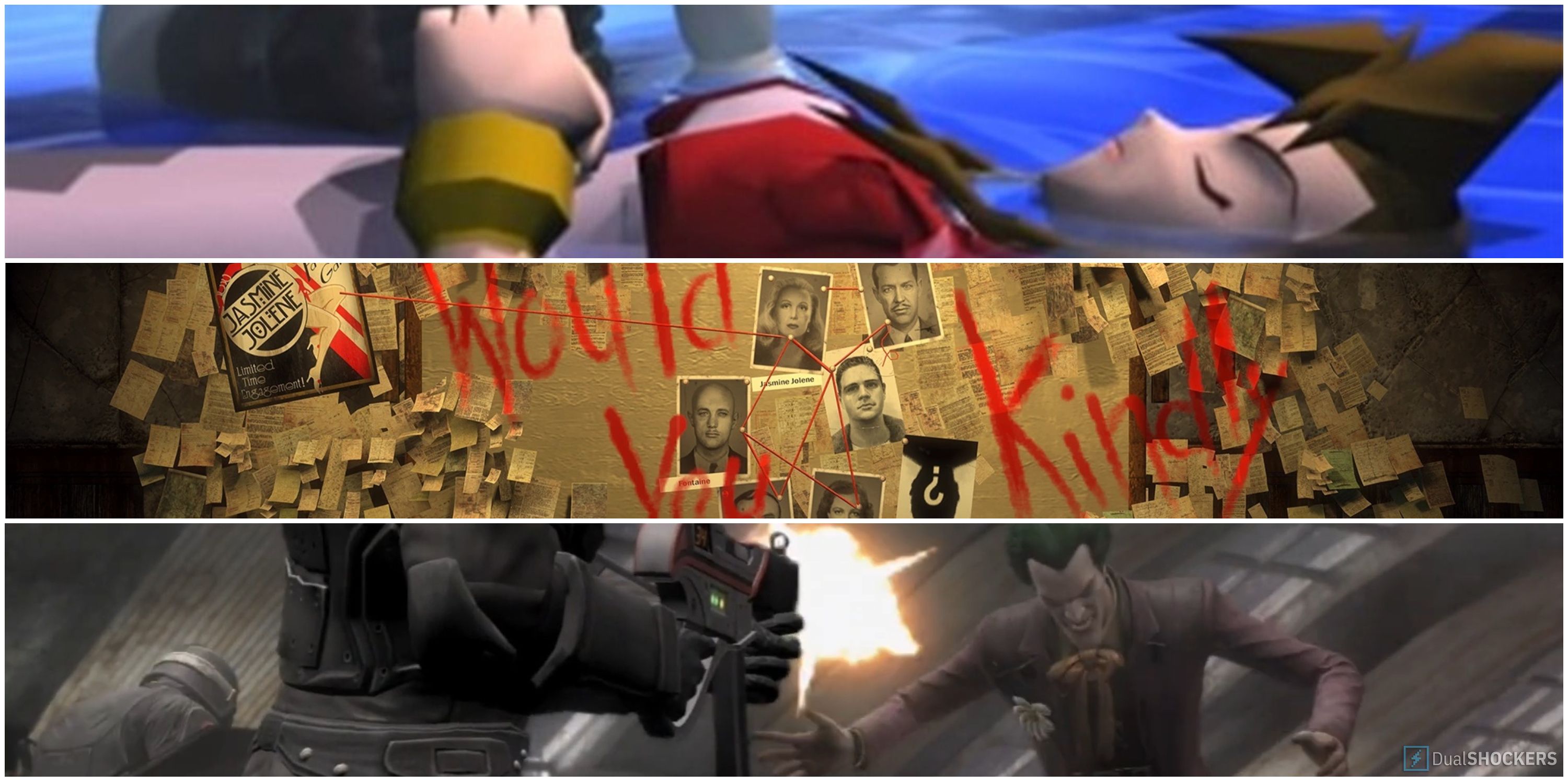
“Ludonarrative dissonance” is a term coined in 2007 by video game designer and director Clint Hocking.
The term breaks down like this: ludus, the Latin word for game, the game’s narrative, and the dissonance, or disconnect, between the two.
Related
10 Games With Complex Narratives
There’s no shame in needing to look up what the heck these games are talking about.
In simpler terms, when you as the player experience something in gameplay that directly conflicts with the overarching narrative, that’s an instance of ludonarrative dissonance.
This is a fairly common occurrence, due in large part to gaming’s interactive nature.
You can find instances of ludonarrative dissonance in just about any game with a story if you look hard enough, but here are a few instances that stuck out to us.
10 “Would You Kindly?”
BioShock

BioShock


- Released
- August 21, 2007
- Engine
- havok, unreal engine 2.5, unreal engine 3, vengeance engine
- ESRB
- m
- How Long To Beat
- 12 Hours
- Metascore
- 96
- PS Plus Availability
- Premium (Remastered)
The instance of ludonarrative dissonance that prompted Hocking to coin the term in a blog post came about in BioShock.
Specifically, it’s the infamous twist that the phrase “would you kindly” is a direct trigger phrase used to force the protagonist, Jack, to obey someone.
As a story element, it’s still a great twist, but when mixed with gameplay, it becomes murky.
BioShock’s main gameplay loop revolves around freely exploring areas and looting stuff.
The story may move forward when Atlas says “would you kindly,” but never with the same expediency as it does when you confront Andrew Ryan, simply because nothing will actually progress until you choose to do so.
9 Chaos Control
Sonic Adventure 2

- Released
- June 19, 2001
- Developer(s)
- Sonic Team USA
- Multiplayer
- Local Multiplayer
- Engine
- The Hedgehog Engine
- ESRB
- e
- How Long To Beat
- 9 Hours
In the final boss fights of Sonic Adventure 2’s Hero and Dark stories, you play as Sonic or Shadow battling against your respective counterpart.
These fights are mechanically identical; whenever your opponent falls off the stage, they return with Chaos Control.
The story shows that while Sonic is able to warp with the fake Chaos Emerald Tails made, doing so leaves him exhausted for a few moments afterward.
Despite that, he is able to warp repeatedly, often in rapid succession, while you fight him.
Inversely, neither Sonic nor Shadow can warp at all when you’re controlling them, despite the fact that both should be able to.
8 Zombie Bites
Dead Rising

Dead Rising
Action-Adventure
Survival Horror
- Released
- August 8, 2006
- Engine
- re engine, havok
- ESRB
- m
- How Long To Beat
- 12 Hours
- Metascore
- 85
The zombies in the Dead Rising games play by fairly traditional zombie rules: you get bitten, you turn into a zombie in short order.
Whenever Frank or a Survivor are grappled by a zombie, they’ll take several large, messy bites before they’re shoved off.
However, all this does is knock off some health from Frank or the Survivor’s health bars, with no apparent zombie infection beyond that.
In fairness, the last leg of Dead Rising’s story has Frank “somehow” becoming infected.
However, this inconsistency still holds true for the following Dead Rising games, with neither Chuck nor Nick becoming infected no matter how much they get bitten in gameplay.
7 Heat Actions
Yakuza Kiwami

There’s something of an unofficial rule for fans of the Yakuza/Like a Dragon franchise: “if it didn’t happen in a cutscene, it doesn’t count.”
In the games’ cutscenes, a single bullet or stab wound is usually enough to incapacitate or potentially kill someone.
In gameplay, though, the protagonists’ use of Heat Actions can inflict some truly brutal injuries on people.
When the dust settles, though, the defeated are usually left with no more than some bruised ribs and a bloody nose.
This is true for just about every Yakuza game, though more recent games have partially rationalized it as Ichiban daydreaming about overly-exaggerated fights.
6 Nanotech Pills
Injustice: Gods Among Us

In the story of Injustice, the evil Superman develops special Kryptonian nanotech pills that give the consumer superhuman physical durability roughly equivalent to his own.
This is how the game justifies ostensibly ordinary human characters like Green Arrow, Joker, and Deathstroke being able to go toe-to-toe with superpowered characters.
There’s a bit of a problem here, though: most of these characters fight primarily with weapons like guns, bows, and swords.
While these characters themselves are enhanced, their weapons shouldn’t be any stronger, certainly not enough to hurt the likes of Superman.
Nevertheless, because gameplay necessitates balance, you can shoot Superman with an ordinary pistol.
5 New-U Stations
Borderlands

Borderlands
- Released
- October 20, 2009
- Multiplayer
- Local Multiplayer
- Engine
- Unreal Engine 3
- ESRB
- m
- How Long To Beat
- 23 Hours
- OpenCritic Rating
- Strong
Whenever you’re killed in one of the Borderlands games, you immediately respawn at the nearest New-U station with a nominal fee deducted from your cash reserves.
Obviously, this needs to exist for gameplay purposes; it’s a living, open world, and you need to be able to revive somewhere in-world while your companions keep fighting.

Related
Borderlands: 10 Character Deaths That Still Sting
Though the games have their roots in comedy, the character deaths in the Borderlands game hit hard.
However, if revival is so easy, why does nobody take advantage of it in the story? For instance, why do Roland or Handsome Jack’s deaths in Borderlands 2 stick when they should be just as capable of using a New-U station?
The games’ developers have waffled a bit on simply declaring the New-U stations non-canon, which would be the simplest justification.
Persona 5 Strikers


- Platform(s)
- PS4, PC, Switch
- Released
- February 3, 2021
- Engine
- Proprietary Engine
- ESRB
- M for Mature: Blood, Partial Nudity, Sexual Themes, Strong Language, Violence
- How Long To Beat
- 35 Hours
- Metascore
- 83
- OpenCritic Rating
- Strong
In Persona 5 Strikers, all the Phantom Thieves’ usual haunts for weapons and medicine are closed for the summer.
To keep the gear flowing, especially after they get on the road, their new AI friend Sophia utilizes a dark web delivery service.
This is rationalized away in a silly cutscene where multiple delivery drivers show up in the span of a few minutes.
However, in the game’s final arc, EMMA has placed all of Tokyo’s residents in a trance state by removing their desires and sealing them in a new Jail in Tokyo Tower.
There shouldn’t be much, if any commerce in this state, but somehow, Sophia is still perfectly capable of ordering stuff and getting it delivered.
3 Project Purity
Fallout 3

Fallout 3
- Released
- October 28, 2008
- Publisher(s)
- Bethesda Softworks
- Engine
- Gamebryo
- ESRB
- M for Mature: Blood and Gore, Intense Violence, Sexual Themes, Strong Language, Use of Drugs
- How Long To Beat
- 23 Hours
- Metascore
- 93
- PS Plus Availability
- Premium
At the end of Fallout 3’s main story quest, the Lone Wanderer and company successfully wrest Project Purity from the Enclave’s control.
However, the control room for the purifier has been suffused with radiation, and if you enter to turn it on, you will certainly die.
If you have radiation-resistant companions available like Fawkes or Sergeant RL-3, the most sensible thing would be for them to do it.
However, if you ask, your rad-proof buddies flat-out refuse, insisting that this is your “destiny.”
This is a rare instance of ludonarrative dissonance that was fixed later on; with the Broken Steel DLC installed, your rad-resistant friends will agree to go in and handle it.
2 V’s Ticking Clock
Cyberpunk 2077

- Franchise
- Cyberpunk
- Released
- December 10, 2020
- Engine
- REDengine 4
- ESRB
- M for Mature: Blood and Gore, Intense Violence, Nudity, Strong Language, Strong Sexual Content, Use of Drugs and Alcohol
- How Long To Beat
- 25 Hours
- X|S Optimized
- Xbox Series X|S players can also download Update 2.1 and enjoy all the new content available in the game
- Metascore
- 75
- PS Plus Availability
- N/A
- Steam Deck Compatibility
- yes
- OpenCritic Rating
- Strong
- Cross Save
- yes
- Cross-Platform Play
- ps, xbox, pc
In Cyberpunk 2077, following V’s resurrection by the Relic biochip with Johnny’s engram on it, they’re given devastating news: they’re going to die.
By Viktor’s estimate, the biochip’s overwrite process will completely destroy V’s personality in favor of Johnny’s in the span of a few weeks.
As the game does have a day/night cycle, it’d be reasonable to worry about the main quest being on a time limit.
The reality is that no matter how long you fart around Night City, shooting punks and completing sidequests, V won’t die from the biochip process.
You can bumble around for hundreds of in-game days and be no worse for wear.
1 Aerith’s Death
Final Fantasy VII

Perhaps one of the oldest cited instances of ludonarrative dissonance is Aerith’s tragic death at the hands of Sephiroth in Final Fantasy VII.
Players have asked for years why Cloud didn’t try to cast Cure or use a Phoenix Down while Aerith was fading.
After all, it’s these same abilities and items that revitalize and revive your party members in combat with equally dangerous foes.
The generally-accepted fan justification is that Phoenix Downs just revive someone from unconsciousness, not death.
In all likelihood, there’s no canon reason beyond it just being more dramatic not to revive Aerith.

Next
Bioshock Creator Explains The Future Of Interactive Narratives
Ken Levine, the creator of hit series like Bioshock, explores how he stretches the concept of game narratives in his upcoming title Judas.


